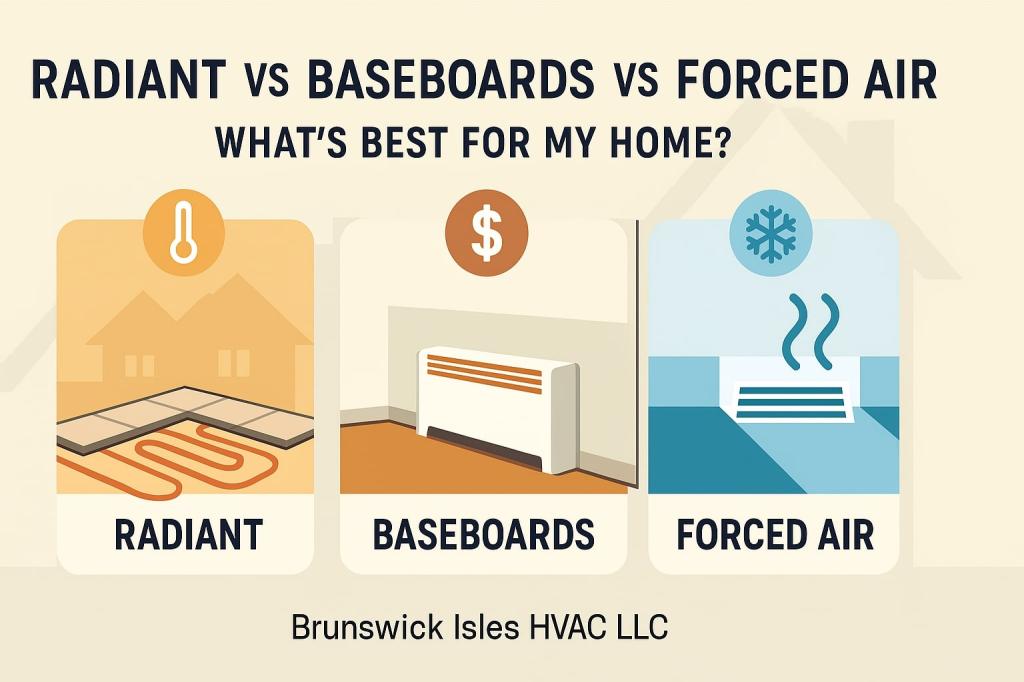
If you’re weighing radiant floor heating vs baseboard vs forced air, you’re really deciding how you want heat to move through your home—by warming surfaces, warming air at the perimeter, or circulating warm air through ducts. This guide breaks down how each system works, where each shines, and how to choose for comfort, cost, and efficiency. As your local specialists, Brunswick Isles HVAC LLC can design, install, and maintain the right solution for your space and climate.
The quick gist (who wins at what)
| Priority | Radiant Floors | Baseboards | Forced Air |
|---|---|---|---|
| Even, draft-free comfort | ⭐⭐⭐ | ⭐⭐ | ⭐ |
| Lowest operating costs (mild climates) | ⭐⭐⭐ (with heat pump/condensing boiler) | ⭐⭐ | ⭐⭐ (with high-efficiency heat pump) |
| Lowest upfront cost | ⭐ | ⭐⭐ | ⭐⭐ |
| Fast temperature changes | ⭐ | ⭐⭐ | ⭐⭐⭐ |
| Cooling compatibility | ⭐ | ⭐ | ⭐⭐⭐ (same ducts) |
| Allergen control/filtration | ⭐ | ⭐ | ⭐⭐⭐ (filters, IAQ add-ons) |
| Zoning simplicity | ⭐⭐ | ⭐⭐⭐ | ⭐⭐ |
Bottom line: Radiant floors = peak comfort; baseboards = simple zoning and lower install complexity; forced air = best for whole-home heating and cooling with strong filtration and fast response.
How each system works
Radiant floor heating
- How it heats: Warmth radiates from tubing (hydronic water lines) or cables/mats (electric) embedded beneath finished floors. It warms surfaces and people directly, then gently warms the air.
- Fuel/energy: Hydronic radiant pairs with gas, propane, or electric boilers—and increasingly with air-to-water heat pumps. Electric radiant draws grid power.
- Comfort feel: Uniform, enveloping warmth with minimal stratification and no drafts. Tile and concrete feel luxurious; wood requires careful design.
Baseboard heaters
- How it heats: Perimeter units along exterior walls warm air via convection; cool air enters at the bottom, passes warming elements (electric or hydronic), and rises as a gentle plume.
- Fuel/energy: Electric resistance or hot water from a boiler.
- Comfort feel: Warmer perimeters and cooler interiors; slower mixing than forced air, but simple and quiet.
Forced air (furnace or heat pump)
- How it heats: A burner or heat pump warms air in an air handler; a blower pushes it through ducts to registers in each room. The same ducts can deliver chilled air for AC.
- Fuel/energy: Natural gas/propane furnaces, or electric heat pumps that both heat and cool.
- Comfort feel: Quick to change temperature; may feel drafty without proper diffuser design. Humidification and filtration are easy add-ons.
Pros and cons you’ll actually notice
Radiant floors
Pros
- Silky, consistent warmth at foot level; no cold corners.
- No duct noise, no whistles, no blowing dust.
- Excellent efficiency with condensing boilers or air-to-water heat pumps.
- Invisible—no grills, registers, or baseboard runs.
Cons
- Highest upfront cost and most intrusive retrofit (best during new builds/renovations).
- Slow response; it’s a “set-and-let-it-work” system, not for frequent setbacks.
- Cooling still needs a separate solution (ducted or ductless) unless you add fan coils.
- Floor coverings matter—thick rugs or certain woods reduce output.
Baseboards
Pros
- Lower installation complexity; great for additions and apartments.
- Very quiet; easy room-by-room zoning with simple thermostats.
- Hydronic versions pair nicely with high-efficiency boilers.
Cons
- Electric resistance models can be costly to operate long-term.
- Takes up wall space; furniture placement can block airflow.
- No cooling; IAQ add-ons (filtration/humidity) are separate.
- Temperature can feel uneven—warm by the walls, cooler in the center.
Forced air
Pros
- One infrastructure for heating, cooling, filtration, humidification, and air cleaning.
- Fast temperature changes and easy smart-thermostat control.
- Very efficient with modern variable-speed heat pumps and high-AFUE furnaces.
- Works well for whole-home dehumidification in humid climates.
Cons
- Duct design and sealing are critical—leaky or undersized ducts waste energy and create noise.
- Can feel drafty or dry without proper diffuser selection and humidity control.
- Filter changes matter; neglect leads to dust and performance loss.
Costs: install and operation (what to expect)
- Radiant floors: Highest install cost, especially in retrofits (floor demo, pour/plates, manifolds, controls). Operates efficiently with condensing boilers or air-to-water heat pumps—great for steady, moderate setpoints.
- Baseboards: Low-to-moderate install cost. Electric resistance has low upfront but higher utility bills. Hydronic baseboard costs more to install (boiler + piping) but offers better operating economics.
- Forced air: Moderate install when ducts exist; higher if ducts must be added or corrected. Operating cost is excellent with cold-climate heat pumps or high-efficiency gas furnaces. Bonus: ducts also serve cooling.
Tip: In mild-winter regions, a high-SEER2, high-HSPF2 heat pump often delivers the best lifetime cost—especially when ducts are tight and properly sized.
Comfort, air quality, and noise
- Comfort: Radiant wins for “toes-to-head” evenness. Forced air wins for quick recovery and whole-home cooling. Baseboards sit in the middle—gentle but not as uniform as radiant.
- Air quality: Forced air shines; it supports MERV-rated filtration, whole-home humidifiers/dehumidifiers, and UV/air cleaners. Radiant and baseboards do not move air, so IAQ requires separate devices.
- Noise: Radiant is nearly silent. Baseboards are quiet with occasional expansion ticks. Forced air can be whisper-quiet with variable-speed blowers and well-designed ducts; poor ductwork gets noisy.
Zoning and controls
- Radiant: Excellent multi-zone potential (manifolds and room thermostats). Best run with outdoor-reset controls for smooth, efficient water temps.
- Baseboards: Easiest zoning—each room often gets its own stat. Simple and effective.
- Forced air: Zoning is possible but must be engineered (zone dampers, bypass strategy, variable-speed equipment). Alternatively, use multiple ductless/mini-split zones.
Climate and home type fit
- New builds & major remodels: Radiant floors are superb—design them in from the start and pair with efficient generation (condensing boiler or air-to-water heat pump). Add fan coils or a small ducted system for cooling.
- Additions, attics, basements: Baseboards (hydronic or electric) offer a quick, low-impact way to heat new spaces without altering the main system.
- Whole-home upgrades or existing ductwork: Forced air with a modern heat pump or high-AFUE furnace provides heating, cooling, and IAQ in one package.
Decision guide: choose by scenario
- “I want spa-level comfort and I’m renovating floors.”
Choose radiant floors. Pair with an air-to-water heat pump or condensing boiler; plan a cooling strategy (ducted or ductless). - “I need simple, room-by-room control for an addition or apartment.”
Choose baseboards. Go hydronic for better long-term cost, electric for lowest install. - “I want one system for heat, AC, and filtration with fast response.”
Choose forced air with a variable-speed heat pump (or gas furnace + AC where gas is economical). - “My ducts are old and leaky.”
Either fix and right-size the ducts (often the best total value) or consider ductless/mini-split zones as a forced-air alternative.
One more resource you can trust
For fundamentals, equipment types, and efficiency tips, the U.S. Department of Energy’s Energy Saver provides clear explanations: Home Heating Systems – DOE Energy Saver.
Talk to a local pro you can trust
No two homes—or comfort goals—are alike. The best system aligns with your envelope (insulation, windows), floor finishes, existing infrastructure, and budget. Brunswick Isles HVAC LLC can measure heat loss, assess duct health, model operating costs, and present clear options with timelines and pricing.
Ready to choose confidently? Contact Brunswick Isles HVAC LLC for a right-sized, future-proof heating plan—whether that’s silky-smooth radiant floors, simple baseboard zoning, or a high-efficiency forced-air system that handles heating, cooling, and clean air in one.